Dishop
Dishop helps restaurants sell direct, run their deliveries, and keep their customers coming back, with no commission on sales.
- Services
- Design
- Development
- Stack
 Webflow
 GSAP
 Cloudflare
 HubSpot
- Industry
- SaaS
- Food & hospitality
- Credits
 Pulsor (opens in a new tab),Design
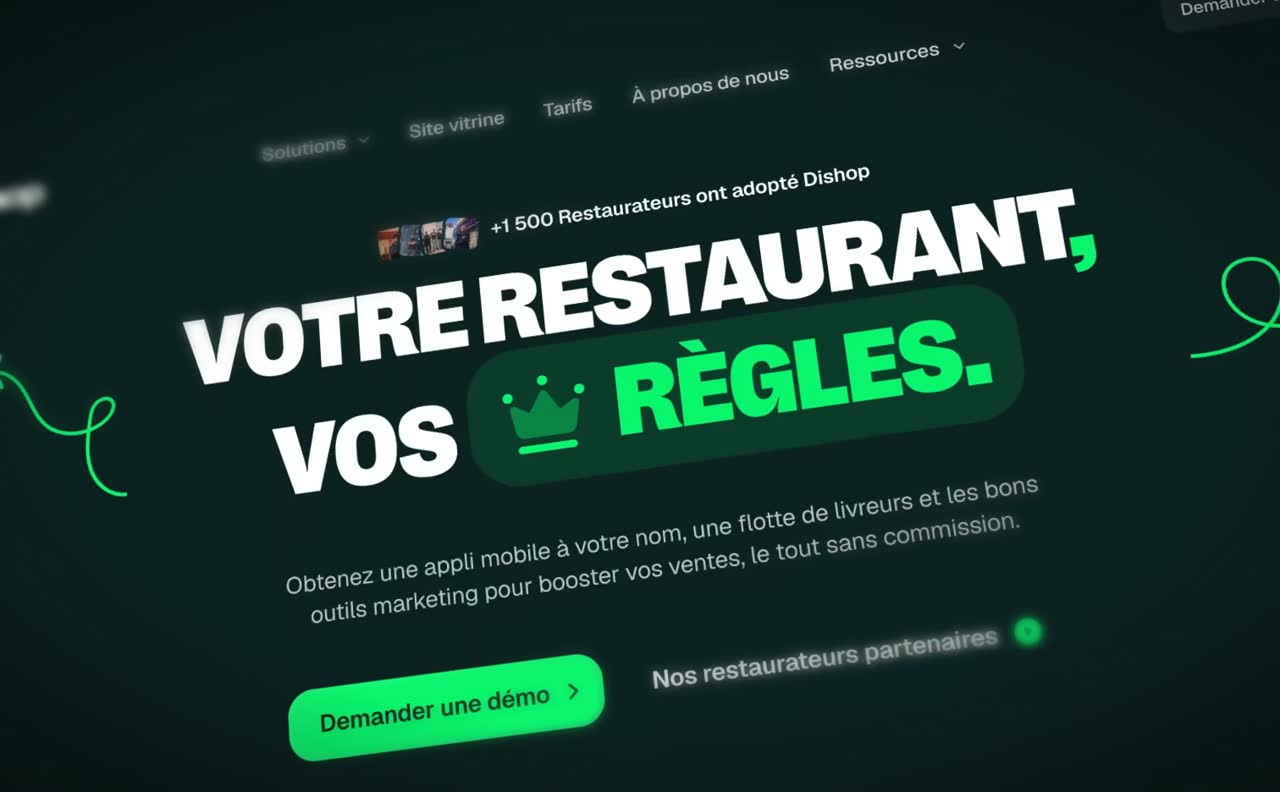
I built Dishop’s new  Webflow site with
 Pulsor, to make the offer concrete, back the sales conversations, and let the team keep its content up to date.
The challenge
Dishop had grown by focusing on its product and its customers. Word of mouth worked and restaurants stayed, but the company wanted new ways to grow.
Its brand and its site had to match that ambition. The old site presented the offer in terms too technical for its audience, without making it clear what Dishop could change in a restaurant owner’s day.
The redesign had to make that value obvious, build trust, and serve two sales goals: bring in new restaurants, and show existing customers more of what Dishop can do.
The approach
Understanding the product comes first
Once the first version was built, Thomas and I saw that the journey had become too complex. With Pulsor, we proposed reworking it around what restaurant owners actually expect.
The pages present the solutions through real situations: taking orders, organising deliveries, or bringing customers back. I built the demos and interactions that let visitors explore these uses right on the site.
With so many videos and animations, their technical cost had to stay in check. They load and play according to what each page needs, so nothing runs all at once for no reason.
Letting owners picture it for themselves
No commission means more once it’s set against a restaurant’s own numbers. I built a calculator that estimates the savings from the revenue made on delivery platforms, with Dishop’s own cost factored in.
Visitors can compare the models against their own situation. Testimonials and case studies round out the picture with other owners’ experience.
Letting the team keep growing the site
I structured the case studies to hold whatever proof each customer has: testimonials, videos, benefits, and hard numbers. Dishop can publish new stories without rebuilding the layout each time.
The old  WordPress articles came over too, with the redirects they needed. Editable content and getting-started guides let the team keep feeding the site after the handover.
Connecting requests to the sales pipeline
I connected the Webflow forms to  HubSpot through a
 Cloudflare Worker. Each request creates or updates the matching contact, with the prospect’s details, their restaurant, and their message.
The sales team finds every request in the tool it already uses, without copying anything over from the site.
The outcome
The new brand and the redesigned site changed how Dishop is seen, inside the team and by its customers.
Thomas says the team was proud of the new site straight away. With customers, it showed up as real requests: owners who’d turned down a testimonial six months earlier were now asking to be featured.

We had loads of customers asking us: ‘Why aren’t you doing that with me?’
Dishop already had a product its customers were loyal to. Together with the new brand, the new site makes them want to stand for it too.